

Study Background
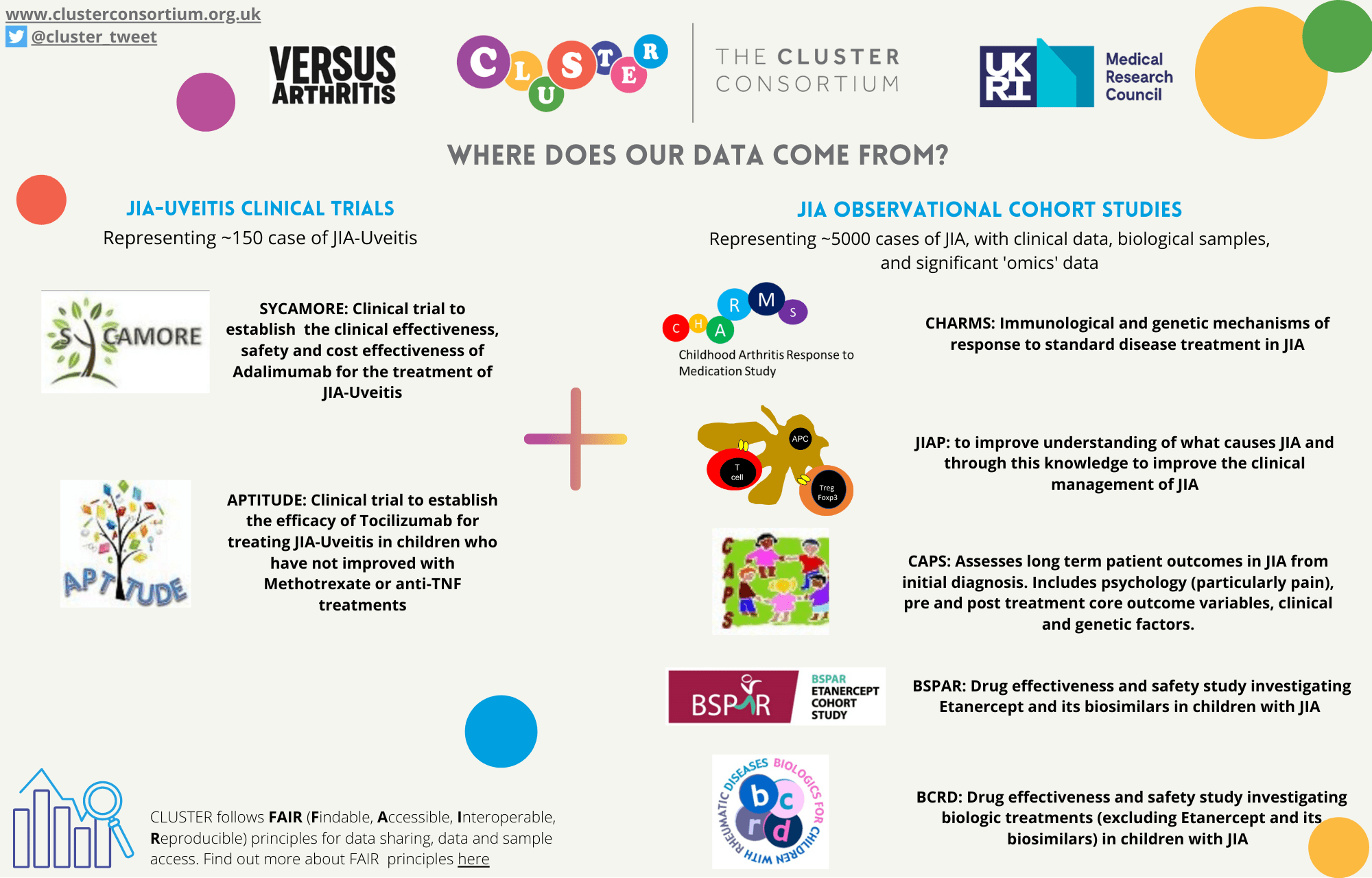
CLUSTER builds on the successes of the UKRI MRC-funded consortium project CHART, which brought together a number of other studies:
- Childhood Arthritis Prospective Study (CAPS)
- Childhood Arthritis Response to Medication Study (CHARMS)
- Biologics for Children with Rheumatic Diseases Study (BCRD)*
- BSPAR-Etanercept registry (BSPAR-Et)*
Alongside these, CLUSTER will include new data and samples from two JIA-uveitis clinical trials (SYCAMORE & APTITUDE) to develop and grow the data and sample network.
Considerable evidence supports our confidence that ‘JIA-strata’, or groups, can be defined that would facilitate personalised approaches, and improve children’s lives and outcomes. Our goal is to define distinct biomarkers of childhood arthritis and JIA-uveitis, reflecting treatment response and disease course.
Find out more about CLUSTER’s datasets and data access policies here.
* Now known collectively as the UK Biologics Registers (BSPAR ETN and BCRD)
The specific scientific aims of CLUSTER are to:
Discover, replicate and validate biomarkers for prediction of treatment response to drive stratified medicine approaches in JIA and JIA-uveitis.
Identify mechanisms and pathways in JIA and JIA-uveitis to define novel therapeutic targets and facilitate stratification.
Identify disease and treatment-response strata with markers for stratification.
CLUSTER Work-strands

Within such a complex spectrum of conditions, a multi-disciplinary consortium with experts in molecular science, genetic immunology, biostatistics and clinical outcome analysis, is essential to integrate multi-dimensional data successfully.
CLUSTER is made up of five work-strands that feed into each other for the common goal of integrated stratified medicine and validation.
Find out more about CLUSTER’s datasets and data access policies here.
Work-stream 1 – JIA-Arthritis (Lead: Professor Stephen Eyre, co-lead Professor Wedderburn)
CLUSTER will build on success of the MRC-funded consortium CHART project, comprising 5000 JIA patient cases with biosamples and data, and include new cases and groups.
To achieve this ambitious goal, CLUSTER will analyse a unique collection of patient groups and generate new highly detailed and mapped, JIA datasets.
The key aims of WS1 are to:
- Discover, replicate and validate protein biomarkers for prediction of outcome and response to medication.
- Assess new cases to contribute to integrated analyses.
- Generate predictors.
- Deep analysis to further understand the molecular mechanisms involved in therapeutic response and discover disease ‘endotypes’.
Work-stream 2 – JIA-Uveitis (Lead: Professor Beresford, co-lead Professor Ramanan & Professor Dick)
WS2 will use the clinical datasets of the two uveitis clinical trials (SYCAMORE, APTITUDE) to generate data to define endotypes. WS2 will work closely with WS1 and WS3 to integrate discovery regarding the biology of JIA-uveitis.
The key aims of WS2 are to:
- Enable identification of clinical, genetic and other predictors of uveitis.
- Identify biomarkers for treatment non-response and response in uveitis.
- Understanding mechanisms of JIA uveitis.
Work-stream 3 – Data Integration, analysis and modelling for patient stratification (Lead: Dr Wallace)
This work-stream will establish an analysis team working closely with the other work-streams. The work-stream will link and integrate data into a web-based knowledge management platform entitles TranSMART.
The key aims of WS3 are to:
- Integrate the available UK JIA clinical and genetic datasets within TranSMART/i2b2 – eMedlab environment (http://www.matura.whri.qmul.ac.uk/TranSMART.php).
- Collate existing omics data, QC existing and new data and samples, and lead on statistical experimental design in WS1 and WS2.
- Integrate and explore all data, to define clinical and distinct strata and endotypes.
- Construct and disseminate transferable methodologies, applicable to other stratified medicine collaborative efforts (RA, psoriasis, SLE), and other fields of medicine.
Work-stream 4 – Industry Partnership (Lead: Professor Ramanan, Co-lead Professor Beresford)
Work-stream 4 aims to work in partnership with industry partners to deliver future trials of novel biological therapies. Industry analysts will be integral to our analysis team, interacting closely with WS1, WS2 & WS3.
The key aims of WS4 are to:
- Establish through our senior global industry partners a collaborative CLUSTER-industry committee for facilitating disease endo-phenotype identification for disease stratification and biomarker development.
- Explore all opportunities for collaboration with the researchers to repurpose existing drugs for JIA.
Work-stream 5 – Stakeholder engagement and management (Lead: Professor Wedderburn, Co-lead Professor Kimme Hyrich)
Crucial to success of CLUSTER will be stakeholder engagement with patients, families, Industry, clinical colleagues, and national and international collaborative networks. To ensure that tools resulting from the work of CLUSTER are responsive to the needs of the child and families, child-appropriate and acceptable in clinical use, we will work with patients and clinicians at every stage of the process of strata definition, biomarker testing and clinical implementation. We will collaborate with patients, parents and associated charities to empower patients and families to help inform and direct discovery and implementation of treatment stratification.
Working with existing Parent and Patient Involvement and Engagement (PPIE) groups, such as YOURRhuem; ARUK-EATC4Children; and the ARUK-Adolescent Rheumatology Centre to develop the CLUSTER Parent and Patient Network (PPN).
Two partner charities (GOSHCC, OV) are co-funding some of these activities and child-friendly events, providing added benefit to the proposal.
Success of WS5 aims on developing:
- Patient groups: CLUSTER will actively engage with key organisations including the British Society of Paediatric and Adolescent Rheumatology (BSPAR) and BSPAR-parents group, the ARUK-supported National Youth Advisory Panel, disease charities (CCAA, OV and NRAS-JIA), and at European level the European Network for JIA, ENCA.
- Electronic communication: Families have emphasised the importance of a comprehensive, accessible CLUSTER website. We will post lay summaries of all CLUSTER events, and publications, and provide regularly updated information, posting regularly on social media sites, to ensure high visibility through digital media.
- Public events: we will hold JIA-stratified medicine family events, sharing progress of CLUSTER illustrated through multi-media means, and providing networking opportunities, bringing all our PPIE partners together. We will work closely with the wider healthcare community, professional organisations, other Stratified Medicine consortia (MATURA, MASTERPLANS), NICE, and Clinical Commissioning groups, to disseminate findings widely.
To find out more about work-stream 5, please contact the PPIE officer through clusterconsortium@ucl.ac.uk